


T: +86-18156545248
E: info@wnksensor.com
E: info@wnksensor.com
5F, Bldg. 2A, Mingzhu Industrial Park Hefei 230000, China
Views: 0 Author: Site Editor Publish Time: 2025-11-17 Origin: Site
In the high-stakes world of industrial processing and automation, the difference between peak efficiency and catastrophic failure often relies on the accuracy of a single variable: pressure. Precise data allows operators to optimize flow rates, conserve energy, and maintain safety margins. Conversely, a sensor failure can lead to unplanned downtime, environmental hazards, or compromised product quality. For engineers and procurement leaders, the challenge is no longer just finding a device that measures force; it is about selecting instrumentation that survives harsh environments while delivering actionable intelligence.
This guide moves beyond basic definitions to provide engineering-grade selection logic. We examine the nuances of sensing technologies, from traditional strain gauges to advanced micro-electro-mechanical systems (MEMS). The goal is to equip you with the technical criteria necessary to evaluate pressure sensors for complex industrial automation, automotive safety systems, and modern IoT implementations. By understanding the interplay between measurement references, media compatibility, and connectivity, you can reduce total ownership costs and ensure long-term system reliability.
Match reference to reality: Choosing between Gauge, Absolute, and Differential measurement is the first failure point in specification.
Technology trade-offs: Piezoresistive offers sensitivity, while Capacitive handles overpressure better; MEMS dominates high-volume automotive and IoT applications.
Connectivity shifts: The transition from analog (4-20mA) to digital (IO-Link, LoRaWAN) is redefining sensor utility in predictive maintenance.
Hidden costs: Total Cost of Ownership (TCO) relies heavily on media compatibility (wetted materials) and calibration stability, not just unit price.
Before evaluating materials or output signals, engineers must define the reference pressure. This is the zero point against which the process pressure is compared. Misunderstanding this fundamental concept is a common source of specification errors, leading to readings that drift with weather changes or fail to account for system backpressure.
In procurement and engineering discussions, terms are often used interchangeably, yet they represent distinct hardware classes. Specifying the wrong device type can lead to signal incompatibility with your PLC or control system.
Sensors (Millivolt Output): These are basic sensing elements without internal signal conditioning. They produce a raw millivolt (mV) output that is directly proportional to the supply voltage. They are low-cost but require external amplification and are susceptible to noise over long wires.
Transducers (Voltage Output): These devices include internal circuitry to amplify the raw signal into a standard voltage range (e.g., 0-5V or 0-10V). They are easier to interface with standard electronics but can still suffer from signal degradation over very long cable runs.
Transmitters (Current Output): The industry standard for robust automation, transmitters output a current signal, typically 4-20mA. Current signals are immune to voltage drops over long distances and electrical noise, making them ideal for factory floors.
Absolute sensors measure pressure relative to a perfect vacuum (zero reference). They are sealed hermetically during manufacturing. You typically select these for applications where the measurement must be independent of atmospheric fluctuations.
A primary use case is barometric monitoring or altitude sensing. In industrial vacuum packaging, an absolute sensor ensures that the vacuum level is consistent regardless of the weather outside or the facility's elevation. If a gauge sensor were used here, a low-pressure storm front could artificially alter the vacuum reading, leading to inconsistent packaging seals.
Gauge pressure is measured relative to the current atmospheric pressure. These sensors have a vent—a small opening that allows ambient air to reach the back of the sensing diaphragm. This ensures that the sensor reads "zero" when open to the atmosphere, regardless of altitude.
Common use cases include measuring fluid levels in vented tanks or monitoring tire pressure. However, the vent presents a vulnerability. In humid or wash-down environments, moisture can enter the vent and corrode the internal electronics. High-quality gauge sensors utilize IP-rated breathable vents (often Gore-Tex) that allow air pressure to equalize while blocking water ingress.
Differential sensors measure the difference between two distinct pressure points, often labeled as "high" and "low" ports. They do not reference the atmosphere or a vacuum.
Engineers rely on these for flow measurement using the pressure drop across a venturi or orifice plate. They are also standard for filtration monitoring in HVAC systems. As a filter clogs, the pressure on the upstream side rises relative to the downstream side. The sensor detects this delta and triggers a maintenance alarm. In oil and gas separators, they detect the interface level between two immiscible fluids.
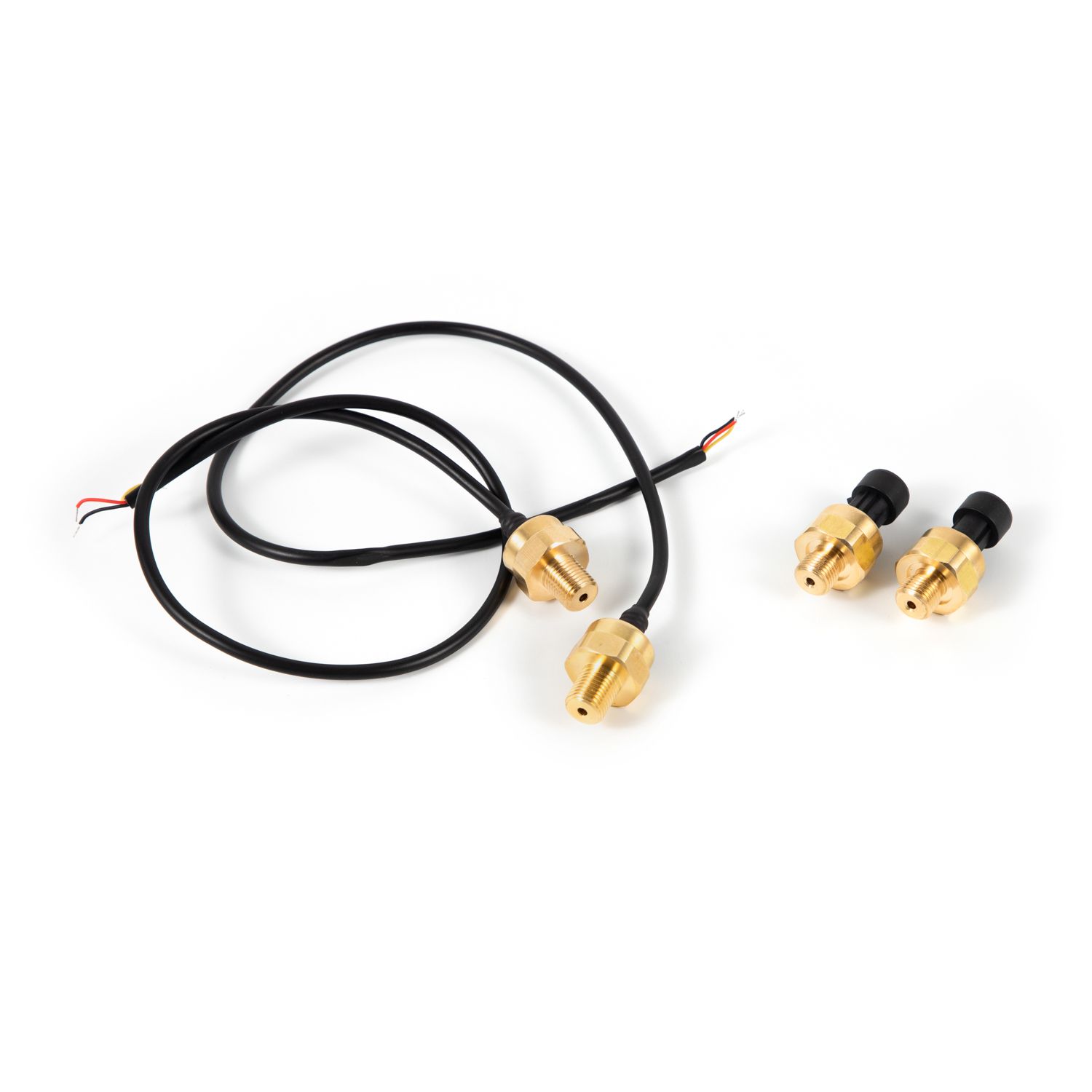
Once the reference type is established, the next critical decision involves the sensing technology. The internal mechanism dictates the sensor's accuracy, overpressure tolerance, and suitability for dynamic measurements.
| Technology | Primary Benefit | Primary Limitation | Typical Application |
|---|---|---|---|
| Resistive / Piezoresistive | High sensitivity & linearity | Temperature drift (requires compensation) | Hydraulics, General Industrial |
| Capacitive | High overpressure tolerance | Larger physical footprint | Tank Leveling, Low Pressure |
| Piezoelectric | Fast response to dynamic changes | Cannot measure static pressure | Combustion, Explosions |
| MEMS | Miniaturization & Scalability | Limited to lower pressure ranges typically | Consumer Electronics, IoT |
This technology relies on the principle that the electrical resistance of a material changes when it is mechanically deformed. Strain gauges are bonded to a diaphragm; as pressure deforms the diaphragm, the resistance changes, which is measured by a Wheatstone bridge circuit.
Piezoresistive sensors, specifically, use semiconductor materials that offer sensitivity factors far higher than traditional metal foil gauges. They provide excellent linearity and accuracy. However, silicon is sensitive to temperature, so these sensors require sophisticated thermal compensation circuitry. Manufacturers often choose between Diffused Silicon (oil-filled for shock protection and high precision) and Ceramic (mechanically robust and corrosion-resistant). This technology is the standard for a heavy-duty Oil Pressure Sensor found in hydraulic machinery, where high pressure and rapid cycling are common.
Capacitive sensors detect pressure by measuring the change in capacitance between a fixed plate and a flexible diaphragm. As pressure applies force to the diaphragm, the gap between the plates narrows, altering the capacitance.
These sensors are renowned for their robustness. They handle overpressure events better than strain gauges because the diaphragm can bottom out against the substrate without breaking. They are also extremely power-efficient, making them suitable for battery-powered remote units. Their high sensitivity at low ranges makes them ideal for draft measurement in furnaces or precise tank leveling applications.
Unlike resistive or capacitive types that measure displacement, piezoelectric sensors generate an electrical charge when the crystal lattice is compressed. This effect is instantaneous, making them the superior choice for measuring highly dynamic events.
Because the charge dissipates quickly, these sensors cannot measure static pressure; they would read zero in a constant-pressure tank. However, for capturing the pressure curve of an explosion or the rapid pulses of fuel injection, they are unmatched. This characteristic makes them the standard technology for an Automotive Pressure Sensor designed for engine knock detection, where the sensor must distinguish high-frequency combustion anomalies from normal engine vibration.
MEMS technology has revolutionized the sensor market by etching mechanical structures directly into silicon wafers, integrating both the sensing element and the logic circuitry on a microscopic scale. This allows for mass production similar to computer chips, driving down costs significantly.
The business value of MEMS lies in scalability. While they may not always match the extreme durability of a macro-scale fused silica sensor, their size and price point enable ubiquitous deployment. They are the driving force behind the integration of sensors into consumer electronics, medical devices, and high-volume automotive production lines.
The method by which a sensor transmits data is undergoing a radical shift. For decades, the analog 4-20mA current loop was the undisputed king of industrial connectivity. While reliable, it is a one-way street: the sensor sends a process value, and the controller receives it. There is no room for diagnostic data.
In a traditional analog setup, if a wire breaks or the sensor drifts, the controller might interpret the zero signal as a valid low-pressure reading or fail to detect the inaccuracy until a process error occurs. Furthermore, secondary data—like the internal temperature of the sensor or the number of pressure cycles it has endured—remains trapped inside the device, inaccessible to the asset manager.
Digital connectivity unlocks the "trapped" data. Protocols like IO-Link allow sensors to communicate bi-directionally over standard three-wire cables. Operators can change parameters remotely, re-range the sensor, and read serial numbers without stepping onto the factory floor.
For remote applications, such as pipelines crossing vast distances, wireless architectures are essential. An IOT Pressure Sensor equipped with LoRaWAN (Long Range Wide Area Network) can transmit data over kilometers with minimal battery usage. NB-IoT (Narrowband IoT) leverages existing cellular infrastructure for utility metering, while Bluetooth allows technicians to configure devices via smartphone apps during installation.
Modern smart sensors are not just data pipes; they are edge processors. They can analyze the raw pressure waveform locally. Instead of sending terabytes of raw data to the cloud, the sensor can trigger an alarm only when it detects a specific anomaly, such as the "water hammer" effect or pump cavitation.
This capability is the cornerstone of predictive maintenance. By monitoring subtle drifts in pressure or analyzing the frequency of pressure ripples, the system can predict pump failure or filter clogging days before it happens. This shifts the maintenance strategy from reactive (fix it when it breaks) to proactive (fix it during scheduled downtime).
A sensor that works perfectly on a datasheet may fail within hours if it is chemically incompatible with the process media or unable to withstand the physical environment. A rigorous evaluation framework is necessary to prevent premature failure.
The "wetted materials" are the parts of the sensor that come into direct contact with the process fluid. Standard sensors typically use 316L Stainless Steel, which provides adequate resistance for water, hydraulic oil, and benign gases.
However, aggressive media require specialized alloys. For seawater or hydrochloric acid, materials like Hastelloy C276 or Monel are required to prevent stress corrosion cracking. In the food and beverage industry, or when dealing with viscous sludge, the shape of the interface matters as much as the material. Engineers should specify Flush Diaphragm designs for these applications. Unlike standard threaded ports where fluid can stagnate and clog, a flush diaphragm presents a flat surface that is swept clean by the flow, preventing bacterial growth or blockage.
Temperature cycling causes expansion and contraction that can introduce hysteresis errors—where the sensor reads differently as pressure increases versus when it decreases. If the application involves wide temperature swings, check the "Total Error Band" specification rather than just accuracy at room temperature.
Vibration is another killer of electronics. For mobile hydraulics, heavy machinery, or compressors, standard housings may crack. Ruggedized sensors with potted electronics and high shock ratings (often measured in g-force) are mandatory to ensure the internal wire bonds do not fatigue and snap.
Regulatory compliance is often a go/no-go criterion. In the oil and gas sector, sensors placed in explosive atmospheres must carry ATEX or IECEx "Intrinsically Safe" ratings, ensuring they cannot spark and ignite flammable gases. For sanitary applications, 3-A or EHEDG certifications prove that the sensor design is hygienic and cleanable. In the automotive supply chain, manufacturers must adhere to IATF 16949 standards, which govern quality management for critical safety components.
Procurement decisions often hinge on unit price, but the purchase price is only the tip of the iceberg. The Total Cost of Ownership (TCO) includes installation, maintenance, downtime risks, and replacement frequency.
Consider a scenario where a \$50 MEMS sensor is selected for a high-vibration rock crusher to save money over a \$200 ruggedized industrial model. If the cheaper sensor fails due to vibration fatigue, the resulting downtime to replace it could cost the operation \$5,000 per hour. In this context, the "expensive" sensor yields a far higher ROI by preventing production stoppages.
All sensors drift over time. The specification to watch is "Long-Term Stability," often expressed as a percentage of full scale per year (e.g., ±0.1% / year). A sensor with poor stability requires frequent recalibration, which involves labor costs and process interruption. Investing in a stable sensor extends the maintenance interval, reducing the operational burden on the technical team.
Installation costs can dwarf hardware costs. Wireless IIoT sensors eliminate the need to run conduit and copper wiring across a facility, potentially saving thousands in labor and materials. Similarly, sensors with backward compatibility allow for seamless upgrades of legacy PLC systems without rewriting control logic.
To streamline the selection process, follow this logical progression:
Define the Range: Determine the normal operating pressure and the maximum burst pressure (safety factor). The sensor range should typically be 1.5x the normal operating pressure.
Identify the Chemistry: Analyze the media. If it is corrosive or viscous, select appropriate wetted materials and diaphragm geometry.
Select the Output: Choose between Analog (4-20mA) for control loops or IoT protocols for data-rich monitoring.
Verify Certifications: Ensure the device meets safety (ATEX) or hygiene (3-A) standards required by the facility.
Successful pressure monitoring is an exercise in balance. It requires weighing the need for high-precision data against the harsh realities of the physical environment and the budget constraints of the project. Whether you are deploying a dense network of wireless sensors for predictive maintenance or specifying a single safety transmitter for a high-pressure reactor, the principles remain the same: context dictates technology.
For critical infrastructure, the recommendation is clear: prioritize long-term stability and specific media compatibility over the lowest unit price. The cost of a single failure often exceeds the price of a premium sensor. We encourage you to audit your current sensor inventory. Look for analog blind spots where digitization could provide predictive insights, and identify aging components that may be drifting beyond acceptable limits.
A: The difference lies in the reference point. An absolute pressure sensor uses a perfect vacuum as its zero reference, making it ideal for weather-independent readings or vacuum sealing. A gauge pressure sensor references the local atmospheric pressure, reading "zero" when open to the air. Gauge sensors are used for tire pressure and open tank levels but require venting to accommodate atmospheric changes.
A: You should use a flush diaphragm when measuring viscous fluids, sludges, pastes, or sanitary media (like food and pharmaceuticals). Standard threaded ports create a cavity where thick fluids can clog or bacteria can grow. A flush diaphragm presents a flat surface to the media, eliminating dead volume, preventing clogs, and allowing for easy cleaning.
A: Temperature changes cause materials to expand or contract, affecting the sensing element's output. This is known as thermal drift or temperature error. It can shift the zero point or change the span (sensitivity). High-quality industrial sensors include active temperature compensation circuits to minimize these errors, but extreme temperature cycling can still induce hysteresis.
A: The lifespan varies heavily based on the application. In benign, stable environments, a quality industrial sensor can last 10 to 15 years. However, in applications with high vibration, pressure spikes (water hammer), or corrosive media, the lifespan may be reduced to a few years or even months. Checking the fatigue life rating (often millions of cycles) helps predict longevity.
A: No. Standard sensors often contain oil fill fluids (like silicone oil) or O-rings that are not compatible with high-pressure oxygen. In an oxygen-rich environment, these organic materials can spontaneously ignite or explode. Sensors for oxygen service must be specially cleaned to remove all hydrocarbons and often use inert fill fluids like Halocarbon oil.


