


T: +86-18156545248
E: info@wnksensor.com
E: info@wnksensor.com
5F, Bldg. 2A, Mingzhu Industrial Park Hefei 230000, China
Views: 0 Author: Site Editor Publish Time: 2026-01-05 Origin: Site
The transition from binary on/off HVAC states to sophisticated Variable Air Volume (VAV) and Variable Refrigerant Flow (VRF) systems has transformed how we manage indoor climates. In this modern landscape, precise sensing acts as the nervous system of building automation, dictating everything from fan speeds to damper positions. However, the business stakes of sensor failure are often underestimated. Inaccurate readings do not just cause occupant complaints; they lead to non-compliance with ASHRAE standards and can inflate energy spending by 15-25% due to unnecessary cooling or heating. Furthermore, drifting data often accelerates equipment wear, shortening the lifespan of costly assets.
This article moves beyond basic physics to provide a practical guide for facility managers and engineers. We will explore the operational logic, signal transduction, and critical evaluation criteria necessary to select the right components and optimize system performance.
Differentiation: Understanding the distinction between basic sensors (signal only) and transducers (amplified/conditioned signal) is vital for BMS integration.
Architecture Matters: "True Wet-to-Wet" differential sensors offer superior accuracy over calculated methods for hydronic applications.
The Drift Factor: Long-term stability and auto-zero calibration features significantly impact Total Cost of Ownership (TCO) by reducing maintenance frequency.
Compliance: New low-GWP refrigerants (e.g., R32, CO2) require sensors with significantly higher burst pressure ratings.
To optimize building performance, facility managers must understand what happens inside the device. The conversion of physical force into a digital language drives the entire automation loop.
The industry standard for board-level and duct sensing relies heavily on Micro-Electro-Mechanical Systems (MEMS) and piezoresistive technologies. These devices detect minute deflections in a silicon diaphragm. When air pressure changes, the diaphragm flexes, altering the electrical resistance in a Wheatstone bridge circuit. This method is highly favored for its compact size, rapid response time, and resistance to mechanical shock.
Alternatively, some applications utilize capacitive or thermal sensing. While capacitive sensors offer high sensitivity at low pressures, engineers must remain cautious regarding thermal sensing technologies. Thermal flow-through sensors can suffer from the "chimney effect," where temperature differences cause air movement independent of the HVAC system, skewing data. Furthermore, low-impedance flow-through sensors are susceptible to dust clogging, which degrades accuracy over time. For most standard HVAC duct applications, a piezoresistive Air Pressure Sensor provides the most robust balance of durability and precision.
A common point of confusion arises between the raw element and the finished product installed in the plenum.
The Sensor: This is the raw sensing element. It detects pressure changes and outputs a weak millivolt (mV) signal. It is generally unamplified and uncalibrated, requiring external circuitry to be useful.
The Transducer: This is the fully integrated unit. It houses the sensor element but adds signal conditioning circuitry. The transducer converts the raw mV data into usable industrial signals, such as 4-20mA or 0-10V analog outputs, or digital protocols like BACnet and Modbus. This prepared signal is what the Building Automation System (BAS) ingests to make control decisions.
Selecting the correct reference point is critical for valid data. We categorize measurements into three primary types:
Differential Pressure (dP): The workhorse of HVAC. It measures the difference between two distinct pressure ports. You will find this in filter status monitoring and flow rate calculations.
Gauge Pressure: This references the measurement against local atmospheric pressure. It is essential for piping systems and compressor stages where the system pressure must be higher than the surrounding air.
Absolute Pressure: This references a perfect vacuum. It is critical for sealed refrigerant loops where measurements must remain accurate regardless of altitude or barometric changes.
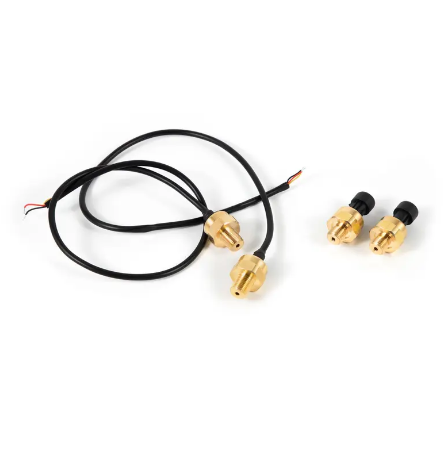
Deploying the right sensing technology directly influences energy bills and maintenance schedules. Below is a breakdown of how specific applications drive tangible business outcomes.
In Variable Air Volume (VAV) systems, the pressure sensor modulates dampers based on duct static pressure. The goal is to satisfy cooling demand with the minimum necessary fan speed. When sensors are accurate, the system avoids over-pressurization.
Outcome: This results in significant energy reduction, as fan power follows a cube law relative to speed. Additionally, proper modulation mitigates air noise, improving occupant comfort.
Traditionally, maintenance teams replaced filters on a fixed schedule, regardless of their condition. By monitoring the pressure drop across filter banks using differential pressure sensors, facilities can shift to condition-based maintenance.
Outcome: Teams replace filters only when the particle load restricts airflow. This reduces material waste and prevents blower motor strain caused by running fans against clogged media.
Certain zones require strict pressure regimes for safety. Stairwell pressurization systems rely on sensors to maintain a positive pressure differential, preventing smoke infiltration during a fire event. Similarly, hospitals and labs use them to keep cleanrooms positively pressurized (keeping contaminants out) or isolation rooms negatively pressurized (keeping pathogens in).
Compliance: These applications are not optional; they are required to meet ASHRAE standards and local fire codes.
Modern sensors monitor high and low-side pressures within the chiller loop. A slow, steady drop in pressure often indicates a leak long before the system fails.
Outcome: Early detection ensures environmental compliance with EPA regulations regarding refrigerant emissions and protects the compressor from running dry, avoiding catastrophic failure.
Not all sensors survive in all environments. A facility manager must match the sensor architecture to the media it measures—air, water, or refrigerant.
Dry-to-Dry: These sensors are designed for non-corrosive gases and air. They are ideal for duct static pressure and room differential pressure. Introducing moisture to these units will corrode the sensing element.
Wet-to-Wet (Hydronic): For water and refrigerant loops, you need wet-compatible devices. Here, the internal architecture dictates accuracy:
| Architecture Type | Mechanism | Implication |
|---|---|---|
| True Wet-to-Wet | Uses a single diaphragm to measure the difference between two wet ports directly. | Decision Point: Offers superior accuracy. Essential for critical chiller and pump applications where precise differential data drives efficiency. |
| Calculated Wet-to-Wet | Uses two separate gauge sensors and subtracts one reading from the other electronically. | Prone to "compound error accumulation." Any drift in either sensor doubles the potential inaccuracy of the differential reading. |
All sensors age. Thermal stress and mechanical fatigue cause the "zero-point"—the reading when no pressure is applied—to drift over time. In a low-pressure application like building static pressure, a drift of just 0.01 inches of water column can confuse the control logic.
Evaluation Criteria: Prioritize sensors featuring automatic zero-point calibration (Auto-Zero). These devices periodically reset their baseline, ensuring they maintain ASHRAE 62.1 compliance without requiring a technician to manually recalibrate them every six months.
The HVAC industry is shifting toward low-Global Warming Potential (GWP) refrigerants like R32, CO2, and R1234yf. These eco-friendly alternatives often operate at much higher pressures than legacy refrigerants like R410a.
Selection Rule: You must verify that the sensor's burst pressure rating exceeds the operating envelope of these new systems. For CO2 systems, operating pressures can be extremely high, requiring specialized heavy-duty industrial transducers.
The purchase price of a sensor is only a fraction of its lifecycle cost. Installation labor, inventory management, and replacement frequency drive the true TCO.
Wiring complexity often surprises contractors. Running conduit for remote monitoring in existing buildings is expensive. Innovation is solving this through Bluetooth-enabled transducers. Technicians can now configure ranges, zero the device, and troubleshoot from a smartphone app without needing to physically access a sensor mounted high in a hard-to-reach plenum. This feature drastically reduces commissioning time and safety risks.
Stocking a unique sensor for every possible pressure range is inefficient. Modern programmable sensors offer multi-range capabilities. A single hardware SKU might cover eight or more selectable pressure ranges (e.g., 0-0.1" up to 0-10" WC).
Benefit: This capability allows facility managers to reduce inventory holding costs. If a sensor fails, the maintenance team can grab a universal replacement from the shelf and configure it on the spot, rather than waiting for a specific part order.
Sensors located in plant rooms or on rooftops face moisture and vibration. Evaluating IP ratings (Ingress Protection) is critical. For areas subject to wash-downs or condensation, an IP65 or higher rating is necessary to prevent water ingress. Furthermore, sensors mounted directly on compressors must have high vibration resistance to avoid false contact warnings or internal wire fatigue.
Choosing the right partner is as important as choosing the right voltage output. The manufacturing process determines the reliability of the data your BAS receives.
When evaluating an air pressure sensor manufacturer, look beyond the brochure. Does the manufacturer offer a documented Mean Time Between Failures (MTBF)? Reliability data should be transparent. Additionally, consider the availability of digital outputs (I2C/SPI). As the industry moves toward the Internet of Things (IoT), sensors that can communicate directly with digital networks offer more value than legacy analog-only devices.
For critical facilities like hospitals and pharmaceutical labs, accuracy is a legal requirement. Manufacturers must provide clear calibration certificates traceable to NIST standards. Supply chain stability is also vital; you need to know that replacement parts will be available with short lead times to minimize system downtime.
Air pressure sensors have evolved from simple safety switches to intelligent data nodes that drive the energy strategy of modern buildings. They are the eyes and ears of the HVAC system, ensuring comfort, safety, and efficiency.
Successful implementation relies on matching the sensor architecture—specifically choosing "True" differential sensing for water and validating media compatibility—to the application. Facility managers should prioritize long-term stability features like Auto-Zero over the lowest initial hardware cost, as the labor savings from reduced calibration usually outweigh the upfront price difference.
Review your current building pressure trends today. Identify areas where upgrading to smart, multi-range transducers can deliver immediate ROI through energy savings and reduced maintenance labor.
A: A switch is a binary device; it is either "on" or "off" based on a set threshold (e.g., proving a fan is running). An air pressure sensor provides continuous, real-time data measuring the exact amount of pressure. This allows for variable control and modulation rather than just safety shutdowns.
A: The sensor measures the pressure before the filter and after the filter. As the filter collects dust, it becomes harder for air to pass through, causing the pressure drop (differential) between the two sides to increase. When this difference hits a set limit, the system alerts maintenance.
A: "True Wet-to-Wet" sensors use a single diaphragm to physically measure the difference between two liquid pressures. This eliminates the compound errors found in "Calculated" systems, which use two separate sensors and subtract their readings electronically. True differential sensors provide higher accuracy for chiller and pump control.
A: Duct static pressure sensors are typically installed approximately two-thirds of the way down the main supply duct. This location ensures the system maintains adequate pressure for the furthest VAV boxes without over-pressurizing the ductwork near the fan.
A: It depends on the sensor technology and the criticality of the application. Standard sensors may need annual calibration. However, high-quality sensors with "Auto-Zero" or automatic calibration features can maintain accuracy for years without manual intervention, significantly reducing maintenance requirements.


