T: +86-18156545248
E: info@wnksensor.com
E: info@wnksensor.com
5F, Bldg. 2A, Mingzhu Industrial Park Hefei 230000, China
Views: 0 Author: Site Editor Publish Time: 2026-06-03 Origin: Site
Continuous process control relies heavily on precise differential pressure (DP) measurement to keep plants running safely. Engineers use these instruments daily to monitor critical variables across demanding industrial environments. However, many buyers fall into a common procurement trap during the selection phase. They over-specify measurement accuracy while severely under-specifying environmental protection and physical mounting needs. This imbalance inevitably leads to premature instrument failure, unexpected leaks, and costly operational downtime.
You need a structured approach to evaluate, specify, and shortlist the right DP instrumentation. We designed this technical, bottom-of-funnel checklist specifically for engineers and procurement teams. You will learn how to align sensor capabilities with your precise operational parameters. By following these guidelines, you will safeguard your processes, select the proper materials, and ensure long-term reliability for your facility.
Using a dedicated differential pressure transmitter prevents the compounded 4% error rate associated with subtracting values from two independent gauge transmitters.
Custody transfer applications require ±0.075% accuracy, while general process monitoring is adequately served by ±0.2%.
Electronic DP systems are replacing traditional oil-filled capillaries in tall tanks (>6m) to eliminate temperature-induced measurement drift.
Total Cost of Ownership (TCO) hinges heavily on integrated manifold selection and correct impulse piping design, not just the initial sensor hardware cost.
Volumetric flow measurement remains one of the most common applications for DP technology. You must define the core flow principle before sizing your instrument. Flow rate is strictly proportional to the square root of the differential pressure. We express this mathematically as Flow = K × √(DP / Density). A dedicated Differential Pressure Transmitter captures this drop across a primary element like an orifice plate.
Pipeline constraints frequently dictate technology choices. Traditional flow meters often demand long, unobstructed pipe runs to stabilize fluid profiles. However, you can combine modern DP transmitters with conditioning orifice plates. They require minimal straight pipe runs. They need as little as two pipe diameters (2D) upstream and downstream. This configuration significantly outperforms Coriolis or magnetic flow meters when you design tight retrofits.
Hydrostatic liquid level measurement offers exceptional reliability. You calculate the level using a simple principle: Level = DP / Specific Gravity. The instrument measures the fluid pressure at the bottom of the vessel.
You must assess the physical tank conditions carefully. DP technology proves superior to radar or ultrasonic alternatives in highly turbulent vessels. It works flawlessly despite heavy agitation, internal mechanical baffles, or thick surface foam. For open tanks, you simply vent the low-pressure side to the atmosphere. For closed tanks, you connect the low-pressure side to the vapor space. This connection properly offsets static blanket pressure.
Comparison Chart: DP vs Alternative Technologies | ||
Application Type | Preferred Technology | Why Alternative Fails |
|---|---|---|
Tight Pipe Retrofit (Flow) | DP + Conditioning Orifice | Coriolis requires 5D+ spacing. |
Agitated Liquid (Level) | Hydrostatic DP | Radar scatters off moving liquid. |
Heavy Surface Foam (Level) | Hydrostatic DP | Ultrasonic absorbs into foam. |
Plant operators must vigilantly monitor expensive filters and heat exchangers. Many engineers fall for the "Two-Gauge" fallacy. They install two separate standard transmitters. They then calculate the pressure difference via control system software. This approach multiplies measurement uncertainty. It creates cascading errors.
You should establish a strict "Poka-Yoke" error-proofing standard. A single unit isolates the net pressure drop perfectly. It completely ignores background system pressure fluctuations. It provides a direct, uncorrupted health metric. Operators can easily spot clogging trends before catastrophic failures occur.
Accuracy requirements dictate the internal sensor architecture. You must verify your exact process needs. Custody transfer applications demand extreme precision. They generally require ±0.075% full-scale accuracy. General process monitoring does not need this level. Standard industrial monitoring is adequately served by ±0.2% accuracy. Over-specifying accuracy wastes budget.
Turndown ratio remains equally important. Ensure the selected turndown ratio matches your true process variability. A wide turndown ratio helps you maintain acceptable accuracy at very low flow rates.
Industrial lines face sudden spikes. You must identify both the standard operating pressure and maximum potential system spikes. Fast-closing valves create dangerous water hammer effects.
Follow these safety guidelines strictly:
Implement a strict 20% safety margin above the absolute maximum system pressure.
Never rely on the standard operating pressure alone when sizing the sensor housing.
Mandate mechanical pressure snubbers for applications highly prone to hydraulic shock.
Chemical compatibility prevents catastrophic seal failures. You should default to 316L Stainless Steel for standard industrial environments. It offers excellent corrosion resistance for most water, oil, and gas applications.
Wetted Material | Best Suited Environment | Common Industries |
|---|---|---|
316L Stainless Steel | Standard industrial media, water, light oils | Water Treatment, HVAC |
Hastelloy C-276 | Highly corrosive acids, chlorides | Chemical Processing |
Monel 400 | Hydrofluoric acid, saltwater | Marine, Offshore Oil |
Inconel | Extreme temperatures, sour gas (NACE compliant) | Oil & Gas, Petrochemical |
Specify Inconel, Hastelloy, or Monel for demanding environments. Highly corrosive, extreme-temperature, or sour gas applications require these specialized alloys. They ensure strict NACE compliance.
Modern control systems demand seamless digital integration. Require a Smart Differential Pressure Transmitter for new installations. These devices provide a standard 2-wire 4-20mA output superimposed with HART protocol. For highly networked facilities, consider Fieldbus or RS485 Modbus. They enable seamless DCS/PLC integration. They also unlock powerful remote diagnostic capabilities. Plant managers can check sensor health without sending technicians into hazardous zones.
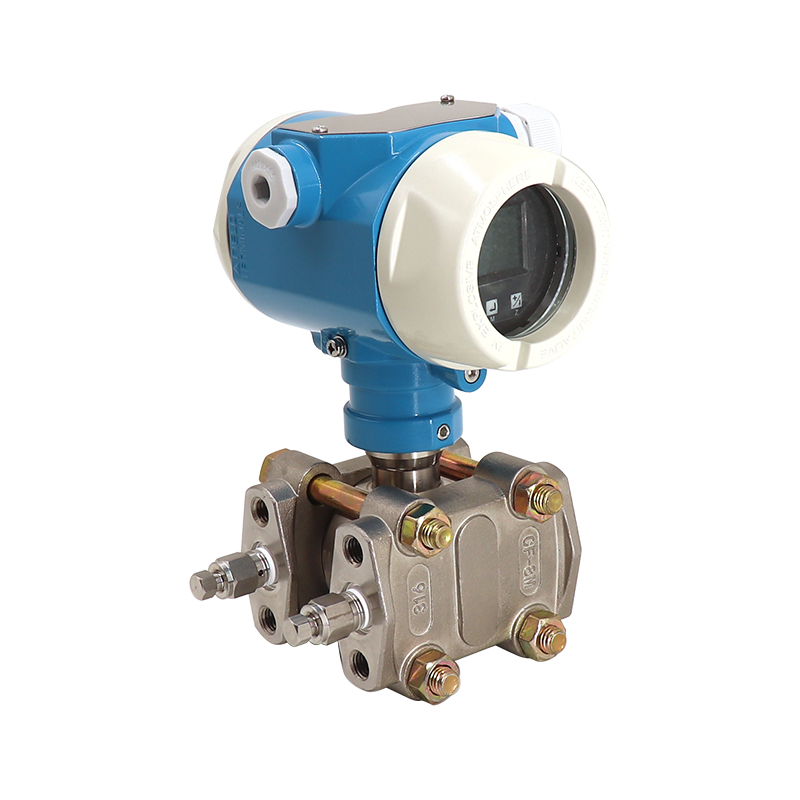
Directly mounting a Industrial Differential Pressure Transmitter onto a hot pipe can destroy its electronics. Use remote seals to isolate the transmitter effectively. They protect sensors from extreme high temperatures. They also handle highly viscous fluids found in pulp and paper manufacturing. Sanitary CIP/SIP cleaning cycles in food processing also demand flush-mounted diaphragm seals.
You must acknowledge a critical risk factor. Symmetric capillary lengths are absolutely mandatory for traditional oil-filled setups. Capillary fluids expand and contract under changing ambient temperatures. Symmetric lengths cancel out these thermal effects perfectly. Asymmetric lines introduce massive measurement drift.
Traditional capillaries struggle on very large vessels. You should evaluate electronic systems for any tank taller than 6 meters.
The new architecture is brilliantly simple. The system utilizes two directly mounted pressure sensors connected by a flexible electrical cable. This entirely replaces the physical oil-filled capillaries.
The operational outcome is outstanding. It completely eliminates thermal expansion errors associated with capillary fill fluids. It also removes severe mechanical installation limitations. Engineers no longer need to route delicate oil tubes through complex plant scaffolding.
Hardware selection goes beyond the main sensor body. You must require integrated 3-way or 5-way manifold valves for all discrete DP installations. Do not pipe directly into the process lines without a manifold block.
We justify this requirement easily. Manifolds are essential for safe instrument isolation. They allow secure process venting. Most importantly, they permit in-line zero verification. Technicians can check the zero calibration point without ever breaking the active process seals.
Impulse pipes carry the process pressure to the sensor. You must design them correctly based on the media phase.
Wet Legs: Engineers use these for condensable vapors like steam. You must actively monitor them for fluid loss. Evaporation skews measurements drastically.
Dry Legs: Engineers use these for non-condensable gases. You must design them to prevent condensation pooling. They require insulated drain pots at the absolute lowest piping point.
Physical mounting orientation dictates long-term accuracy. Gravity profoundly impacts trapped gases and liquids.
For liquid applications, the instrument must sit lower than the process taps. The Pressure Transmitter must be mounted below the piping to ensure any trapped gases naturally vent back upward into the main pipe. For gas applications, you reverse this rule. The transmitter must be mounted above the taps. This allows unwanted liquid condensate to drain away from the sensitive sensor diaphragm safely.
Procurement teams face a fundamental architecture choice. They must decide between discrete setups and fully integrated models.
Discrete solutions separate the transmitter from the primary flow element. They offer high modularity. They allow engineers to upgrade the electronics or recalibrate the unit independently. You do not have to pull the heavy primary element out of the active pipe.
Integrated DP flow meters arrive entirely pre-assembled. The manufacturer factory-calibrates the whole assembly together. This approach significantly reduces potential leak points. It vastly minimizes complex on-site installation labor.
Vendor transparency defines a successful project. You should shortlist vendors who provide clear, transparent uncertainty calculations. They must prove their accuracy claims mathematically under real-world temperature shifts.
Safety certifications remain non-negotiable. Mandate specific hazardous area certifications based exactly on your plant zone classifications. Common global standards include ATEX, IECEx, and CSA. Furthermore, verify the availability of local technical support. Commissioning support and lifecycle calibration services are vital for maintaining plant uptime over the next decade.
Specifying a differential pressure transmitter is an exercise in managing process variables, not just buying a sensor. You must look beyond raw specification sheets. Prioritize material compatibility to prevent chemical degradation. Mitigate environmental temperature extremes by utilizing Electronic DP systems on tall tanks. Ensure proper manifold integration to enable safe maintenance. Finally, recommend engaging directly with your vendor's application engineering team. Provide them with a completed P&ID and process data sheet as your immediate next step.
A: Yes. By leaving the low-pressure port open to the atmosphere, it acts as a gauge pressure transmitter. By sealing the low-pressure side under a true vacuum, it functions as an absolute pressure transmitter.
A: Subtracting readings from two independent transmitters introduces up to four times the measurement uncertainty due to compounded error margins and differing response times. A dedicated DP transmitter measures the exact physical difference directly.
A: Traditional orifice plates may require 10D to 20D straight runs. Modern conditioning orifice plates paired with a DP transmitter can reduce this requirement to just 2D upstream and downstream.